

Automated Cross-region Data Monitoring for a US-based industrial giant


Can Muffins automate operational complexity in large enterprises present in multiple regions?
Yes. Muffins, an AI-embedded no code test automation, is built for sprint-aligned functional testing as well as for operational quality engineering at enterprise scale. Quality risks can rise in large enterprises when their teams still manually validate workflows across regions, environments, portals, and servers.
In this blog we show how Muffins helped the client shift from manual cross-region validation to automated operational monitoring - with data comparison, unit normalization, UI validation, centralized reporting and WhatsApp-integrated alerts working together in one flow.
Our Client’s reality: Daily Operational Validation was still manual
Like many large enterprises in core sectors, our client operates across multiple business regions, each with its own portals, servers, data formats, units of measurement and interface standards.

Every day, teams had to log into multiple regional portals and manually verify whether business critical values were aligned across environments. The checks were quite exhaustive, as they had to confirm whether :
- values matched across portals,
- units were consistent,
- values needed conversion before comparison,
- fonts, font sizes, and UI elements were rendering as expected,
- decimal and regional number formats were being interpreted correctly,
- discrepancies were properly documented.
The process is time-consuming and error-prone. But it is operationally critical as business teams depended on this data to make decisions. A single missed defect could create risk.
The client wanted Muffins to make this daily-cross region monitoring workflow more reliable, efficient and visible.
The Challenge : Not a Regression automation problem
Over a couple of meetings with our client, it became clear that their teams were not looking to automate a regression suite or accelerate releases. The challenge was related to business operations. They needed a process that continuously validate live business data across regional portals, every day, without manual efforts. The complexity existed at 3 levels.

1. UI and Display-level Validation
The team needed to validate fonts, font sizes, and UI related details across regional portals. These checks were important because inconsistent rendering could impact how users interpreted data across environments.
2. Cross-Portal Data Matching
At the next level, the workflow required comparing values displayed on one portal with values displayed on another portal. It is not just a visual check, but needed accurate matching of business-critical data across multiple screens and environments.
3. Unit normalization and Complex business logic
At the most complex level, the portals did not display values in the same unit. For example, one portal displayed values in tons, while the other maintained values in kilotons. The client’s teams had to manage rounding rules, decimal precision, and regional number-format differences -some portals used commas, while others used decimal points. Without normalization, the same value could be interpreted differently across regions. Without standard test automation logic, the workflow cannot be automated.
The Solution: Muffins as an Operational Monitoring Automation layer
We deployed Muffins not just as a No-code test automation platform, but as a daily operational monitoring automation layer for live enterprise workflows – that can continuously validate whether business-critical data remained accurate, consistent and correctly rendered across multi-regional environments.
What began as a simple UI verification use case evolved into a more complex business validation workflow. Muffins automated cross-regional portal comparisons, added unit conversion and rounding logic, handled regional number-format differences, validated UI consistency and turned a repetitive manual process into a reliable automated test flow.
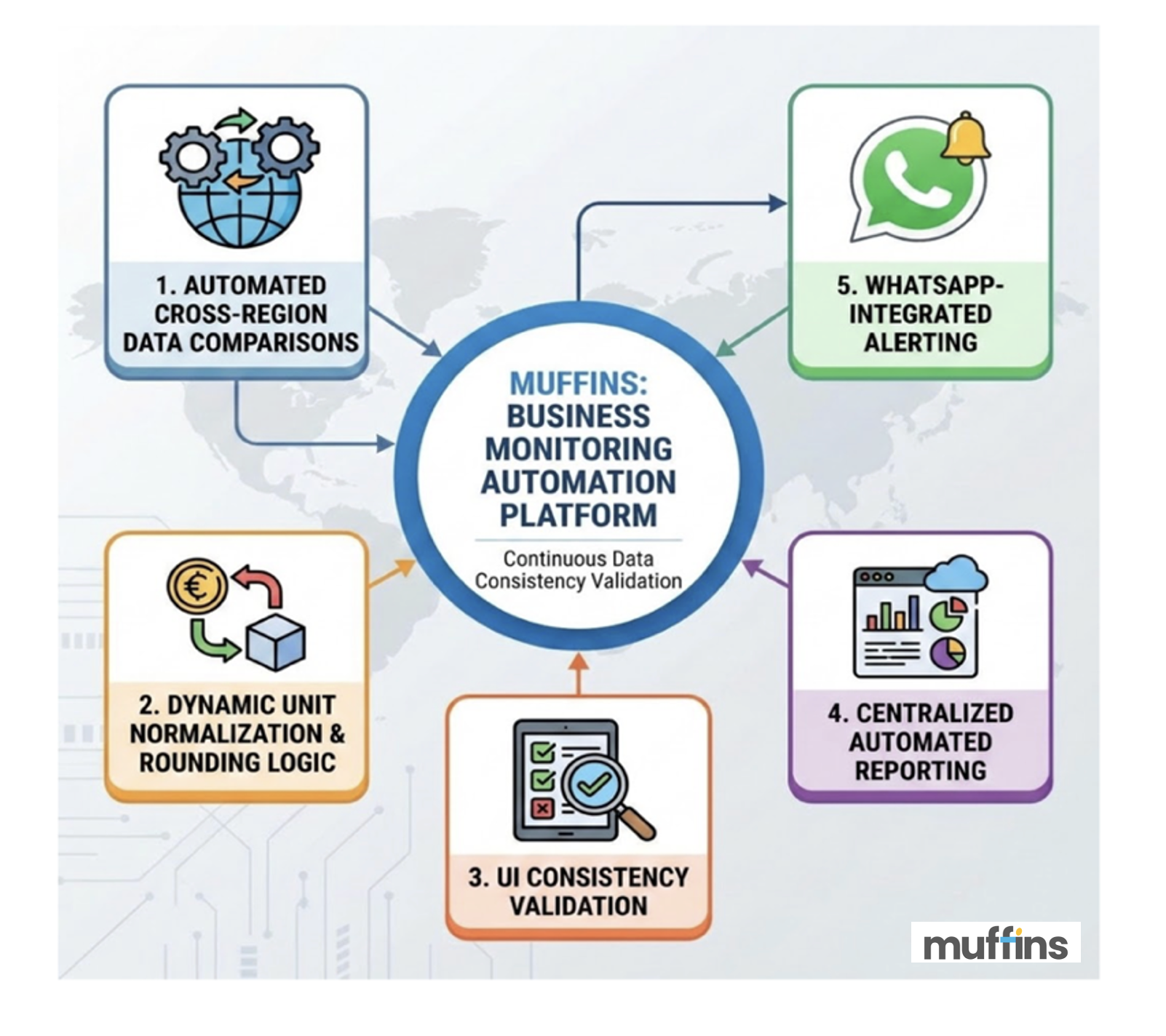
The deployment of Muffins covered five key areas :
1. Automated Cross-Region Data Comparisons
Muffins automated the daily manual validation of key business values across regional portals. Instead of manually logging into multiple portals and comparing values screen by screen, the client’s teams could rely on Muffins to run the comparison workflow automatically. This removed manual effort and the stress of repetitive daily monitoring.
Muffins also handled regional number-format differences, like commas used by one portal, and decimal points used by others. We configured Muffins to read the actual numeric data value instead of treating formatting differences as mismatches or comparison failures.
2. Dynamic Unit Normalization and Rounding Logic
The client’s portals don’t display values in the same unit. One portal shows values in tons, while another displays values in kilotons. Muffins team built a configurable unit normalization interface that allowed our client’s teams to define unit types and apply rounding logic before comparison (from one decimal place up to 10 decimal places).
For example, if a value like 500 tons was compared with a value maintained into kilotons, Muffins converted it to 0.5 kilotons before doing the comparison.
This shows Muffins was not simply comparing what appeared on the screen. It was applying the client’s business logic inside the automation layer.
3. UI Consistency Validation
Muffins checked font types, font sizes, and visual consistency across regional portals. With this our client teams could monitor data accuracy and also interface consistency across all environments.
4. Centralized Automated Reporting
Before Muffins, the client had no centralized visibility into whether the monitoring process had been completely correct every day. There was no automated report and clear audit trail. Muffins created a more reliable reporting layer, which captured all execution results and enabled central reporting, giving stakeholders visibility into monitoring outcomes, discrepancies and execution status.
5. WhatsApp-Integrated Alerting
We understood what senior stakeholders wanted - to receive monitoring results through channels they use daily. Muffins implemented automated reporting via WhatsApp. It began delivering alerts and results directly to decision-makers. The adoption was simple, familiar and frictionless.
What this engagement reinforced about Muffins
Muffins is engineered to address the full spectrum of quality engineering needs : from sprint aligned functional testing to automation of operational monitoring at enterprise scale.
1. Enterprise QA is more about Operational Consistency
In large enterprises, many critical operational workflows carry significant quality risks. These workflows keep business-critical systems aligned, accurate and consistent across regions. Muffins demonstrated that such workflows can be automated with the precision, reliability and consistency expected from modern test automation.
2. Dynamic Operational bottlenecks need Flexible automation
Muffins adapted to the client’s real business environment by supporting :
- cross-region data comparison
- unit normalization
- rounding logic
- regional number-format handling
- UI consistency validation
- centralized reporting
- and WhatsApp-based stakeholder visibility
Why should large enterprises consider Muffins
Large enterprises often operate across multiple regions, environments, servers, portals, and business systems. In such environments, quality engineering is not limited to validating software releases only. It should also ensure that daily operational data remains accurate, aligned, and visible. Muffins helps enterprises automate these broader quality engineering requirements.
The diagram below captures how Muffins can take up the responsibility as an ‘Enterprise Automation & Security Platform’.

- AI-embedded automation that adapts to business logic, not just UI interactions
- End-to-end traceability from requirements through execution results and defects
- Flexible deployment: cloud-hosted, on-premise, or hybrid, including air-gapped environments for high-security requirements
- Enterprise-grade security: SOC 2 Type II certified, ISO 27001 and ISO 9001 compliant, AES-256 encryption
- Integration with the tools and channels which are used by teams, including communication platforms like WhatsApp
If your organization still depends on manual validation across regions, portals, or systems, Muffins can offer a simpler way to embed the most intuitive and pragmatic automation into the operational layer of the business. This keeps business-critical operations consistent, visible and reliable, every day.
Connect with us: sales@muffins.ai, adrian.trevino@muffins.ai
Frequently asked questions
Muffins is an AI-embedded no-code test automation platform with end-to-end quality engineering capabilities. It enables sprint-aligned functional testing as well as automates enterprise-scale operational monitoring workflows.
Traditional test automation tools usually focus on validating software releases within sprints. Muffins can also automate live operational workflows like cross-region data validation, UI consistency checks, daily business monitoring across different enterprise environments. It is SOC 2 Type II certified, ISO 27001 and ISO 9001 compliant, and supports cloud-hosted, on-premise, and hybrid deployments.
Yes. Muffins can automate cross-region data validation by comparing business-critical values across regions, multiple portals, normalising units of measurement, handling number-format differences, and validating UI consistency.
Muffins includes a configurable unit normalisation interface that allows teams to define unit types (for example, tons vs. kilotons) and apply rounding logic before running comparisons. This business logic is embedded directly into the automation layer.
Yes. Muffins supports WhatsApp-integrated alerting, delivering automated monitoring results and alerts directly to teams through channels they already use daily. With this, decision-makers need not log into separate dashboards. The adoption, naturally, is simple, fast and frictionless.
Yes. Muffins is built for enterprise-grade security: it is SOC 2 Type II certified and compliant with ISO 27001 and ISO 9001 standards, with AES-256 encryption. It supports flexible deployment options including cloud-hosted, on-premise, hybrid, and air-gapped environments.
Test automation validates whether software works as expected within sprint cycles. Operational monitoring automation continuously validates whether live business data and workflows remain accurate, consistent and reliable across systems, regions, and environments. Muffins supports both.
Subscribe today.
Thank you!
Client’s reality: Manual Daily Operational Validation
Challenge: Not a Regression automation problem
Solution: Muffins as Operational Monitoring Automation layer
Muffins capabilities reinforced
Why should large enterprises consider Muffins
More related blogs

Structured & Traceable QA for a Mexico-based top Entertainment ticketing company
- May 14, 2025

Smarter Verification and Object Management for Regulated industries
- September 11, 2025
Why Design Thinking Is Essential for Agile Success (Part 2)
- November 30, 2024