

Transition to Test Automation made easy for Manual Testers - Muffins


As Test automation continues to gain traction, many manual testers are trying to transition to automation without losing touch with their domain expertise. They want to seize new opportunities and expand their career potential, in a rapidly evolving Test automation industry. In this blog, we will quickly look at the key challenges Manual testers face when they are shifting to Test Automation, and how Muffins – a No-code AI powered Test automation platform can make their shift easier.
1. Transitioning to Automation – Every Manual tester’s big goal
Long before today’s software-driven world, manual testers have been working to shift to automation. Now, with 71% of organizations using Agile methodologies and 83% of developers engaged in DevOps practices (2024), the pressure for continuous integration and delivery has increased multi-fold.
As the global software testing market reaches $55.6 billion, automated testing is growing rapidly alongside CI/CD pipelines. This evolution is naturally pushing manual testers towards test automation—not only for career progress, but also as a necessary adaptation to modern development workflows, which require faster feedback cycles and continuous quality assurance.
However, this shift comes with its own challenges.
2. Key Challenges faced by Manual testers
Adrian Treviño, our teammate & an Engineer at Muffins Mexico, who transitioned from manual testing to Test automation, said –

Let’s quickly look at some of the frustrating and not-so-familiar hurdles that many manual testers like Adrian Treviño had to face!
2a. Where to start? Which tools & programming language to choose?
The first big challenge is figuring out where to start. There are so many automation tools – Selenium, Playwright, Cypress, Appium… And there are many programming languages too –JavaScript, Python, or Java etc. With so many options, choosing the right stack feels overwhelming. Testers often worry about picking the wrong stack and learning something that may not be useful later.


2b. Automation setup struggles – longer & complex
Testers can start right away with manual testing. But for automation, they had to install dependencies, drivers and set up frameworks, before running a basic script. Technical issues related to configuration, compatibility, missing libraries can pop-up to turn a simple setup into a long troubleshooting process. This can be very frustrating, at times!


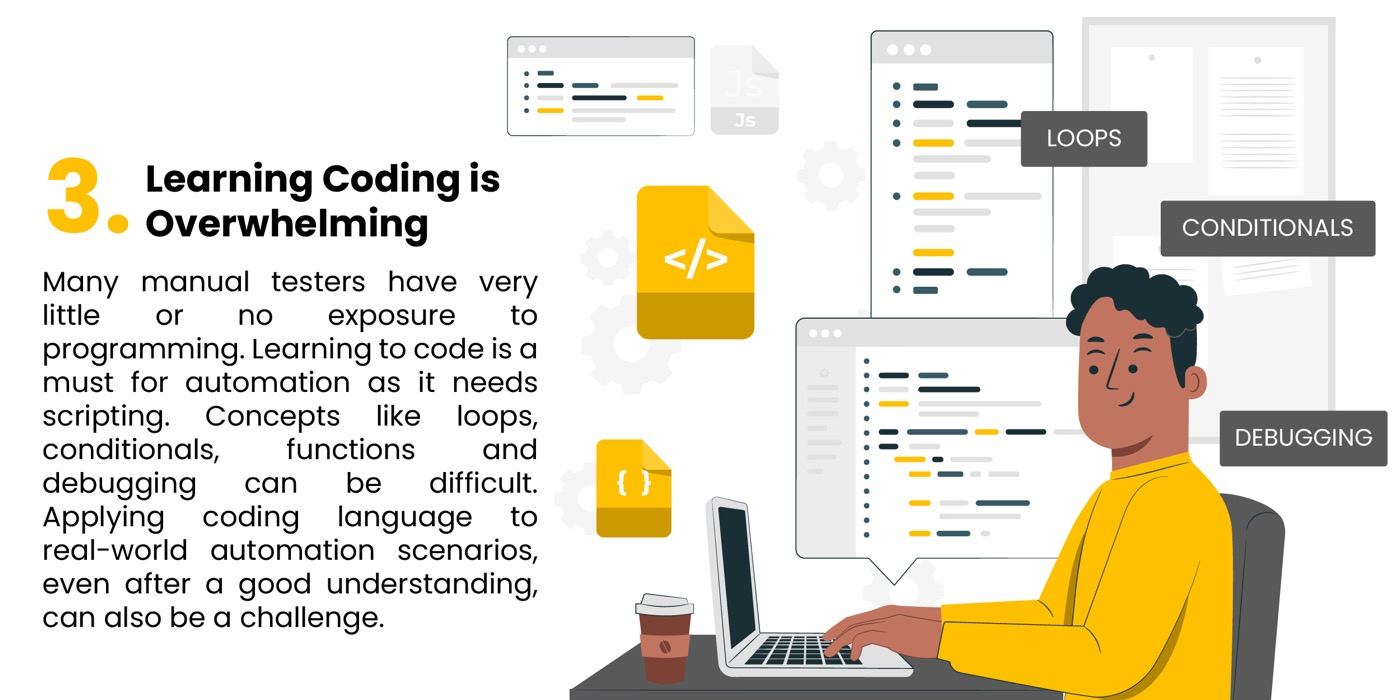
2c. Learning Coding is Overwhelming
Many manual testers have very little or no exposure to programming. Learning to code is a must for automation as it needs scripting. Concepts like loops, conditionals, functions and debugging can be difficult. Applying coding language to real-world automation scenarios, even after a good understanding, can also be a challenge.

2d. Doubts about Maintainable tests
Creating tests is easy, but to ensure them to be stable, reusable and scalable over time can be a big challenge. Many manual testers were not certain if they are following best practices, even after their tests are running. Automation suites can become messy and hard to maintain, if appropriate design patterns are not followed.


2e. Shifting to a new mindset
Manual testers focus on user experience, exploratory testing, intuition and execution. While Automation demands a shift towards logical thinking, efficiency and long-term planning. Testers need to plan tests for long-term efficiency, optimizing performance instead of testing what they have today.


2f. Cycles of Debugging & Troubleshooting

3.How does Muffins make this shift easy for Manual testers
When asked about his experience with Muffins, Adrian Treviño has detailed out how Muffins, a No-code AI powered Test Automation platform, helped him bridge the gap between his manual testing skills and the capabilities that Test automation demands –
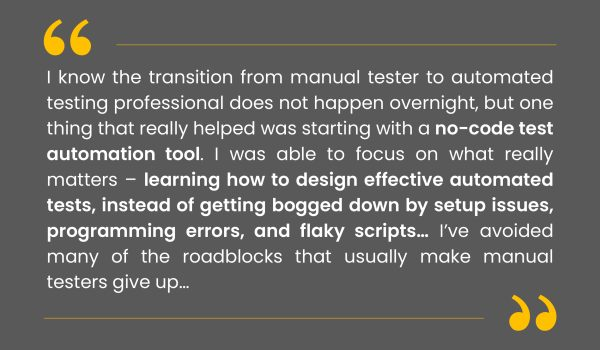
Let’s explore how Muffins, a no-code test automation platform with pre-built features, empowers manual testers to transition smoothly to Test automation while overcoming the typical hurdles along the way.
3.1 No Programming and Coding skills are needed

- Traditional automation tools demand coding knowledge, like Selenium with Java/Python. And this can be a complex learning curve for manual testers. With Muffins, you don’t need any programming skills. Essentially, Zero learning curve. Simple, isn’t it?
- Manual testers can design test scenarios without getting stuck in coding issues
- Muffins’ AI-powered features streamline test creation and execution, reducing the human effort and increasing accuracy. By intelligently guiding testers through the process, Muffins automates repetitive tasks, while ensuring reliable quality.
3.2 No complex scripts, therefore faster adoption

- Testers can create automated tests using visual interfaces, drag-and-drop workflows, and natural language commands. No coding is required.
- Muffins is designed for seamless collaboration – it can be a fantastic play for Business analysts, Product managers, QA teams as well; using Muffins, they can seamlessly explore their application – while they explore, test cases are automatically generated as an outcome. This accelerates testing and maximizes coverage in less time.
- The other big positive factor about Muffins is its scalable architecture – it allows teams to expand test automaton without any kind of worries about infrastructure complexities, making software more accessible and adaptable to evolving needs.
3.3 No Stress around debugging & trouble-shooting
- With every new version of the application, properties inevitably change, making script maintenance tedious and updates challenging. Muffins’ self-healing capabilities handle these changes seamlessly, reducing the effort for keeping scripts updated. With its self-healing capabilities, Muffins eliminates the stress of debugging – automatically adapts tests to UI changes, reduces flaky tests, which together reduces the maintenance load.
- Faster Test execution : Designed for speed and testing efficiency, Muffins automates & runs tests faster than traditional frameworks. It eliminates the need for complex scripting and streamlines test execution, thus allowing teams to focus on quality coverage instead of debugging. The optimized architecture within lets faster feedback loops, enabling faster releases with quality intact.
3.4 Seamless workflows due to robust CI/CD integration

Loaded with quite a few in-built features, Muffins can easily integrate with CI/CD pipelines, test management tools and reporting dashboards. All these together enable a seamless workflow.
3.5 Comprehensive reporting of execution
Muffins’ in-built features ensure seamless tracking and analysis of test results. Its comprehensive dashboards, logs and analytics, provide clear test reporting and management, enabling faster data-backed decisions.
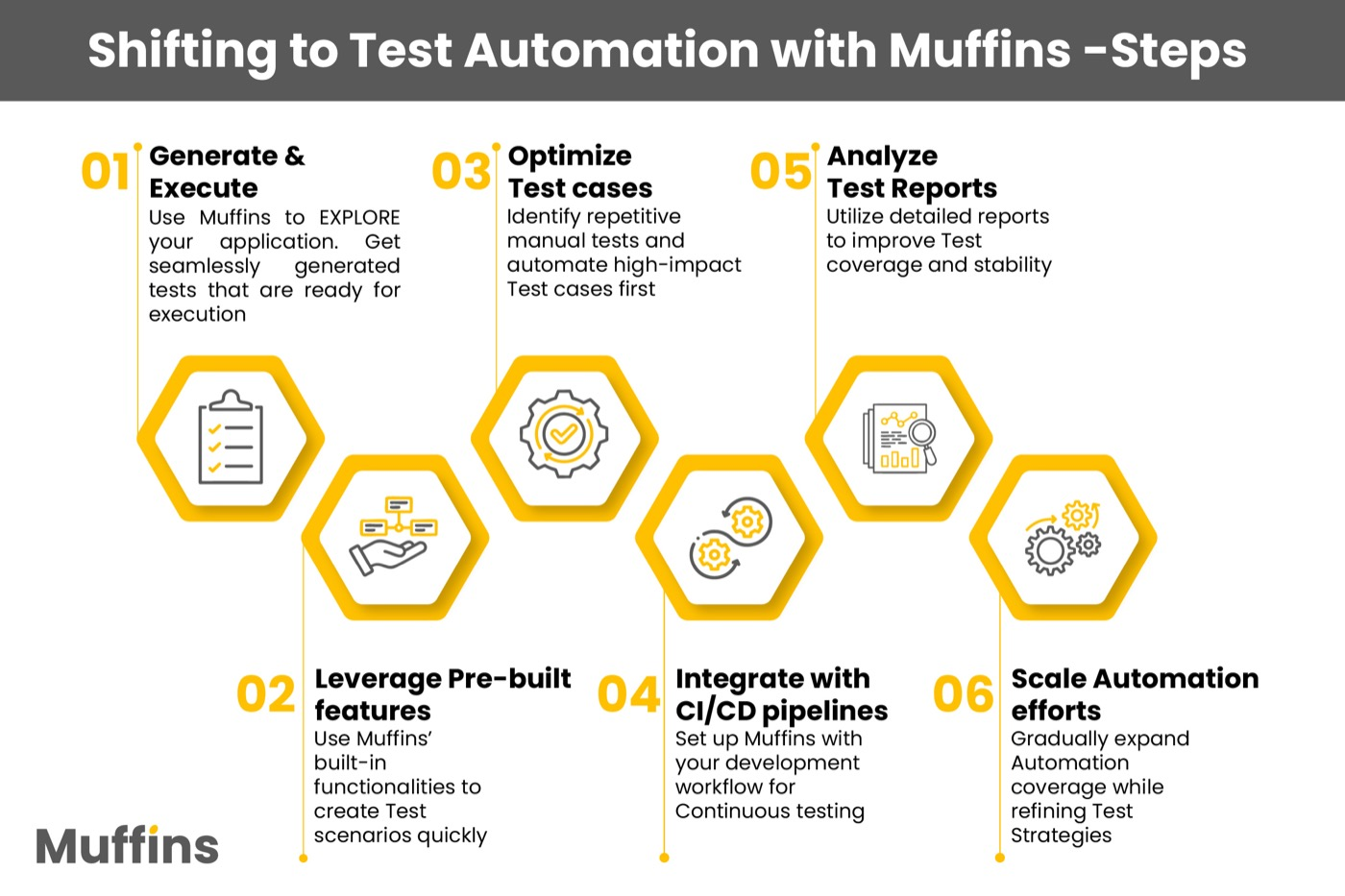
4. Steps – Shifting to Test Automation with Muffins
We have discussed key challenges that manual testers face while transitioning to automation and how Muffins simplifies this process. Now, let’s briefly outline the steps to Test automation with Muffins.

Frequently asked questions
Subscribe today.
Thank you!
Transitioning to Test Automation - The Big goal
Key challenges faced by Manual Testers
Muffins makes the shift to Test Automation easy
Steps - Shifting to Test Automation with Muffins
More related blogs
Types of Software Testing: Manual, Automated & Hybrid
- February 3, 2025

Muffins built seamless document and text verification for a top Mexico-based Manufacturer
- February 3, 2025

Smarter Verification and Object Management for Regulated industries
- September 11, 2025