

The Big Trends shaping Software Testing and Quality Assurance in 2025


‘Every company is a software company’ –
The McKinsey Quarterly dated Dec 2022 noted that - Every business, traditional and new-age, is racing to be ‘tech-enabled’ and shifting to ‘software-driven business model’. Because of this, the stakes for quality assurance have never been higher.
Three distinct software-driven business models are observed by McKinsey team :
- Traditional businesses are reorienting their operations around software to enhance their operational efficiency, customer experience, while many more companies are delivering value to consumers through their products & services embedded with software.
- Companies in certain industries like manufacturing and banking & finance are building software business verticals to complement their existing product range – a new revenue stream is emerging.
- Some legacy and large businesses are converting their internal software solutions into marketable products, and exploring new revenue opportunities.

With every sector embracing digital transformation, the role of software testing and quality assurance (QA) is becoming increasingly significant. There is a rising demand for high-quality software, which naturally is driving up the need for efficient software testing solutions and processes.
The 7 Major Trends Transforming Software Testing and QA in 2025
1. The Dynamic penetration of AI
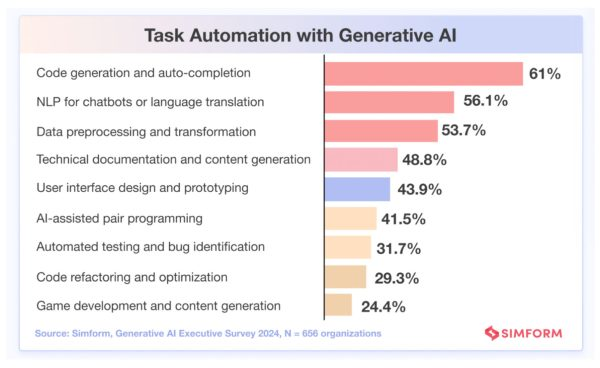
Generative AI is becoming the backbone of modern QA. Simform’s 2024 Generative AI survey confirms the excitement around employing AI – “an impressive 61% of organizations prefer using Gen AI for tasks like Code generation and auto-completion. While 29.3% are using GenAI for Code refactoring and optimization” (source for this data point)
AI-powered tools are delivering measurable gains across the testing lifecycle:
- Automated test case generation from historical data and application logs
- Faster test creation for complex workflows
- Predictive analytics to flag potential system failures
- Intelligent test scheduling and prioritisation
- Self-healing scripts that adapt automatically to UI changes
- Smarter coverage by focusing effort on the highest-risk areas
Muffins addresses the limitations of traditional tools like Selenium and Cypress, which rely heavily on static locators and prone to frequent maintenance as applications evolve. Its ML models analyze DOM structures in real time, dynamically updating test scripts whenever the application under test changes. Key capabilities: intelligent test step generation aligned to business logic, and self-healing automation that slashes maintenance overhead in agile sprints.
2. Shift-Left and Shift-Right Testing
1. Shift-left brings testing into the earliest stages of development - unit testing, BDD (Behavior-driven Development), TDD (Test-driven Development), and continuous integration, so issues are caught when they are cheapest to fix. Ensuring API security with a Shift-left approach involves embedding security measures into the design, coding and testing phase. Through this potential issues in APIs can be identified and mitigated before deployment. By addressing security concerns earlier, organizations can reduce risks, enhance the robustness of their APIs, and save time and resources that might otherwise be spent on addressing issues post-deployment.
2. Shift-right extends the safety net beyond launch. Chaos engineering, A/B testing, and real-time performance monitoring ensure quality holds up under real-world conditions.

Together, these approaches create a continuous quality loop, and end-to-end framework that ensures robust quality assurance process, reduced TTM and improved user experience.
3. Scaling Testing with Cloud infrastructure
Cloud testing is the backbone of modern, large-scale QA. As organisations adopt agile and DevOps, the ability to run parallel test suites across diverse environments, without owning the hardware is becoming a competitive necessity.
- Parallel test execution across configurations reduces cycle time dramatically
- Native integration with CI/CD pipelines enables continuous, automated feedback
- Infrastructure costs and maintenance effort reduce significantly
- Distributed teams get seamless, consistent access to testing environments
4. Performance Engineering over Performance Testing
There has been a growing emphasis on building performance optimization into the entire software development lifecycle. Performance testing asks, “does it work under load?” Performance engineering asks a harder question: “was it designed to perform in the first place?” The shift is from reactive testing at the end of the cycle to proactive design choices made from day one.
Performance engineering takes a proactive approach by designing systems for optimal performance from the beginning, instead of merely testing them after development. This would :
- facilitate stronger collaborations between QA teams, developers, architects and operations in order to identify potential bottlenecks, optimize code and to integrate performance considerations early in the SDLC
- enable QA teams to adopt chaos engineering practices and ensure resilience under adverse conditions
- have teams to utilize observability tools that monitor performance metrics real-time

5. Agentic AI and human - AI collaboration
Agentic AI refers to autonomous “agents” that make decisions, plan actions, and solve problems independently, with minimal human intervention. Salesforce Agentforce, Google Cloud’s Agentspace, Amazon Bedrock from Amazon Web services are early signals of where enterprise software is headed.
Gartner predicts that by 2028, 33% of enterprise software applications will include agentic AI, up from less than 1% in 2024, enabling 15% of day-to-day work decisions to be made autonomously.
Agentic AI, with its advanced capabilities, can offer significant support to testers, no-code test automation platforms, and QA processes.
For Testers
- Smart Test Case Generation: Agentic AI can analyze application requirements, logs, and user behavior to generate optimized and comprehensive test cases.
- Automated Defect Detection: Using AI-driven analytics, it identifies patterns in logs and systems to detect potential issues before manual testing begins.
- Real-time Support: Acts as an intelligent assistant, providing testers with suggestions for edge cases and test improvements.
- Test Data Management: Simplifies the creation of synthetic test data by understanding system requirements and generating diverse datasets.

6. Cybersecurity Testing, the non-negotiable
Since Cybersecurity threats are more prevalent than ever, Cybersecurity testing will become a non-negotiable part of QA. Big waves in security testing would be :

- Integration of security testing tools into CI/CD pipelines for continuous vulnerability assessments
- Penetration testing automation using AI to simulate complex attack scenarios
- Continuous API security testing as APIs become the dominant attack surface
- Compliance testing against GDPR, CCPA, and emerging data privacy regulations
- Ethical hacking integrated into standard QA practice, not siloed in a security team
7. Exploratory testing and UX
Automation dominates headlines, but human judgement remains irreplaceable for discovering what automated tests don’t know to look for. Exploratory testing - adapting strategy in real time based on application context and user personas - consistently uncovers edge cases that scripted tests miss.
QA engineers in 2025 will focus on :
- Adapting test strategies based on application context and user personas
- Leveraging exploratory testing to uncover edge cases and usability issues
- Using advanced tools to document and share exploratory testing insights effectively
UX testing is the other side of the same coin. As digital experience becomes the primary differentiator, teams are investing in usability testing, A/B testing for design decisions, and accessibility testing to meet WCAG standards - ensuring software works for everyone, not just the majority.
Where QA goes from here
Innovations anchored in AI, Cloud computing, etc., and agility & user-centricity will dominate Software testing and QA in 2025. As software becomes more complex, Quality Assurance would evolve from traditional testing to multi-dimensional testing covering cybersecurity, ethical AI etc. Teams that embrace these trends - building quality into every phase of development, not just testing it in at the end, will release faster and retain their edge in today’s fiercely competitive environment.
Frequently asked questions
- Muffins is an AI-powered No-code test automation platform designed to address key challenges in modern software testing. It leverages generative AI to enable efficient test design creation and automation with very little maintenance overhead - making it ideal for agile and DevOps teams in 2025's fast-evolving QA landscape.
- Muffins uses advanced self-healing algorithms that analyze application DOM structures to dynamically adapt and update test scripts when UI changes occur. This reduces maintenance efforts Vs popular traditional automation tools like Selenium or Cypress.
As Generative AI penetrates into testing deeply, with applications in automated test generation, predictive analytics, and self-healing - Muffins stands out due to its no-code capabilities & robust AI features. It empowers teams to overcome various challenges they face with code-based tools, while reducing maintenance & resource costs and accelerating the release velocity.
Subscribe today.
Thank you!
More related blogs

Smarter Verification and Object Management for Regulated industries
- September 11, 2025

How Muffins Simplifies and Scales QA for fast-paced Startups
- January 28, 2026

Structured & Traceable QA for a Mexico-based top Entertainment ticketing company
- May 14, 2025