

Muffins’ Reusable Test Blocks : Built for Reusability, Speed, Scale and Collaboration

Muffins’ Reusable Test Blocks : Built for Reusability, Speed, Scale and Collaboration
Written by Muffins Team
We have built the core of Muffins with No-Code fundamentals - to accelerate the ‘democratization of test automation’ and get everyone (tech, product and business teams) to participate in QA. We are also simplifying life for testers in today’s agile workflows. A recurring challenge is repetitive test steps that consume time, introduce errors, and limit scalability. Testers often end up recreating the same test steps across multiple test cases - especially for common flows like login, form submission, or navigation. Muffins solves this with Reusable Test Blocks, which bring structure, speed, reusability and scalability to test automation.


By combining no-code simplicity with AI-driven intelligence, Muffins transforms Test Blocks from a basic automation feature into a dynamic, sustainable and collaborative QA ecosystem – cutting down repetitive work, reducing errors, accelerating testing and empowering all team members to contribute to faster and high quality releases.
Lets start with a few basics.
1.What are Test Blocks and why do QA teams need them
Flow of the blog
A Test Block is a set of logically grouped test steps bundled together for reuse across multiple test cases.
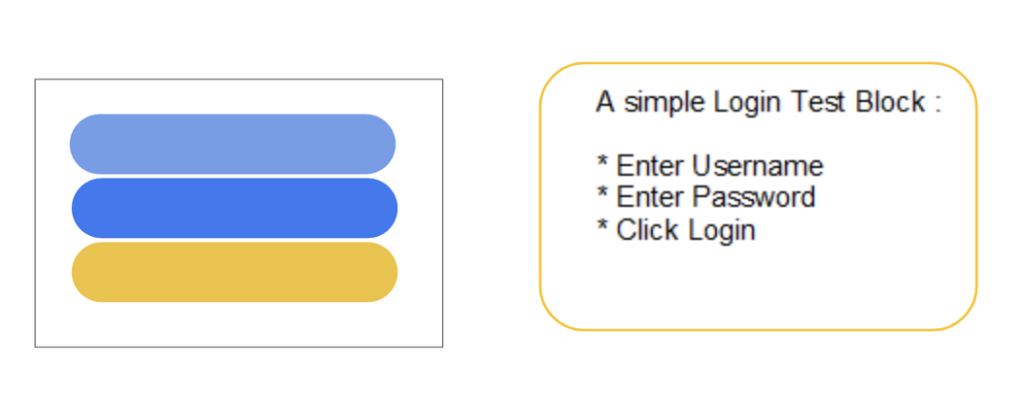
A simple Login Test Block might include ‘Enter Username’, ‘Enter Password’ and ‘Click Login’. Instead of recreating these steps in every test case, each time, teams can simply load a reusable Test Block and apply it anywhere.Test Blocks address the following frequently occurring pain points :


Test automation has long been siloed—fragmented across teams, tools, and expertise. Muffins is changing that.
2.Muffins is creating Collaborative test automation – with Test Blocks
By combining the power of AI with an intuitive interface, Muffins is turning Test Blocks into a collaborative power.
a. Dynamic Reusable Blocks, Not Just Templates
In many traditional test automation tools, reusable components are rigid or siloed. Test Blocks in Muffins are dynamic, flexible and reusable assets stored in a centralized system. Once a Test Block is created, it is available not just to the individual tester but to the entire testing team.
b. Fast Creation, Instant Reuse
The intuitive and No-code interface of Muffins lets anyone create and reuse Test Blocks in just a few clicks. Even non-technical testers can leverage Test Blocks without needing to write code.


c. Collaboration across global teams
Test Blocks in Muffins are not confined to a single user — they are stored in a centralized repository accessible to all team members, across the world. This not only eliminates duplicated efforts but also encourages shared knowledge and efficiency. For example, a team working on an e-commerce platform can maintain a library of Test Blocks for common flows like user registration, product search, or payment processing. Any team member can tap into this library, to save time and ensure consistency.
d. Traceability with Visual Indicators
When a Test Block is reused in a test case, it gets a visual marker indicating that these steps were imported from a reusable block. This feature enhances traceability and maintainability, making it clear which parts of a test case rely on shared components. Such transparency is critical for large-scale test suites, where knowing the origin of test steps can simplify debugging and maintenance.
e. Different Types of Test Blocks
Muffins supports a variety of Test Block types to cater to different testing needs :


Equipped with this versatility, Muffins can adapt to a wide range of testing scenarios, from simple UI tests to complex business workflows.
f. AI-Powered Intelligence
Muffins’ generative AI capabilities set it apart from traditional no-code platforms. The platform does not just store and reuse Test Blocks—it learns from how testers use them. By analyzing patterns in test creation and execution, Muffins can suggest optimizations, flag potential errors, and even recommend relevant Test Blocks for a given test case.
3. Get Started with Muffins’ Test Blocks
Here is how to get started:
- Build Your Block Library: Start by creating Test Blocks for common flows in your application, such as login, registration, or navigation.
- Share with Your Team: Save blocks to the Block repository so that everyone can accesses them.
- Reuse and Refine: Use Test Blocks in new test cases and refine them as your application evolves.
- Leverage AI Insights: Let Muffins’ AI suggest optimizations and recommend blocks to streamline your workflow.
Don’t let repetitive testing slow your teams or compromise quality. With Muffins’ Reusable Test Blocks, you get faster automation, fewer errors, and a collaborative QA framework that scales across projects.
Connect with us - sales@muffins.ai and discover how intelligent, reusable test design can accelerate releases and strengthen compliance.
(Muffins.AI is the no-code test automation platform with intelligent test design at its core. Our powerful generative test design module enables deeper exploration of your web app, uncovering issues early, while execution and defect resolution are fully automated. The outcome? Higher coverage, faster releases with uncompromising quality. You may love to explore our outcome-guaranteed engagement model.)
Frequently asked questions
Subscribe today.
Thank you!
More related blogs

Automated Cross-region Data Monitoring for a US-based industrial giant
- May 25, 2026
Muffins’ Reusable Test Blocks : Built for Reusability, Speed, Scale and Collaboration
- August 19, 2025

Data Parameterization in Muffins
- October 7, 2025