

Why Design Thinking Is Essential for Agile Success (Part 3): Muffins' Intelligent Design Studio


In Part 1 we explored the quality crisis in Agile. In Part 2, we introduced two solutions: Generative Design + Automation, and No-Code Automation with AI capabilities + LLMs & SLMs, and discussed why this hybrid approach can empower teams to generate test cases and automate their execution within a single sprint.
Where does Design thinking actually break down in Agile?
As covered in Parts 1 and 2, Design thinking is applied at the beginning of a project in terms of user stories, requirements, etc and then it quietly disappears once sprints begin. Developers jump into code. Testers work hard to keep up. Design decisions are made under pressure. As a result, the gap between what was planned and what is being built gets wider and wider.
While a pro-design thinking mindset is important, this problem can be fixed with tools -- which connect design to execution, keep teams aligned, and cut down the cost of agility. Muffins’ Intelligent Design studio is built to achieve this seamless integration of design and execution.
What does seamless integration of design and execution actually mean?
One of the most common misalignments in Agile teams is the gap between the teams who design test cases and the teams who automate them - they often use different tools and have different perspectives about quality process & ‘what's good’. If not fixed, such misalignment can lead to costly implications. Integrating test design and execution is key to overcome this misalignment between test case designers and automation engineers. Because this integration :
- reduces rework and maintenance costs
- streamlines collaboration across teams
- fosters a customer-centric approach
- generates robust automation ready test designs
A truly integrated design and execution environment results in :
- Easy creation and execution of test cases
- Easy CI/CD integration
- Automated defect tracking and reporting
- Smooth collaboration between designers, developers, and testers


Muffins' Intelligent Design Studio: Design Thinking in practice
Design is the cornerstone of automation. While automation can be facilitated by tools and technology, poorly designed test cases can significantly lower the value of automation. Muffins’ Intelligent Design Studio empowers designers with intuitive tools to create superior test designs. These designers can be developers, domain engineers, solution architects, or product managers who are familiar with customers’ needs. Low-code and No-code technologies can further streamline the coding process, focusing efforts on strategic design and testing.
A powerful Intelligent Design Studio can create & ensure connectivity between design, execution, CI/CD, and defect management, while seamlessly integrating automation. By simulating human interactions with various tools and platforms, it creates a cohesive process. Such a connected approach allows teams to easily achieve highly reliable end-to-end quality.

Lets see a few key capabilities of Muffins’ Intelligent Design Studio :
1. A simple, intuitive cockpit that anyone can use – No programming skills required
Agile teams often have significant challenges, both from a human and process perspective. Quality engineers encounter these issues across organizations. Therefore, the solution should be intuitive and easy to learn, aligning with the faster pace of agile development. Quality engineers should be able to efficiently design, execute, and report on tests without the need for extensive programming knowledge. By providing a user-friendly interface that allows for plain-English test case creation, automatic generation, and parameterization, we can bridge the gap between design and execution. This empowers engineers to focus on critical tasks like requirements analysis, collaboration with Developers and DevOps teams.
Today, the focus is on generating tests through usage, automation, or reusable components. Creating intuitive, easy-to-use tools that enable users to design tests in plain English, eliminating the need for coding, is becoming a need of the hour. This no-code approach empowers users to generate, parameterize, and execute tests across multiple browsers, significantly improving efficiency and test coverage.
2. Self-Healing Algorithms for reducing Agile’s maintenance cost
How to maintain automation scripts during rapid application changes is one of the biggest challenges faced by quality engineers and automation teams. Agile is not just about building many new test cases and automation, but also about keeping the maintenance cost low. That’s why, no code test automation platforms like Muffins are being equipped with self-healing algorithms, which automatically adapt to changes in the application’s user interface, thus minimizing maintenance efforts. They also minimize the need for manual script updates and extra resources. When the maintenance overheads are taken care of, teams can focus on developing new features and delivering value to customers.
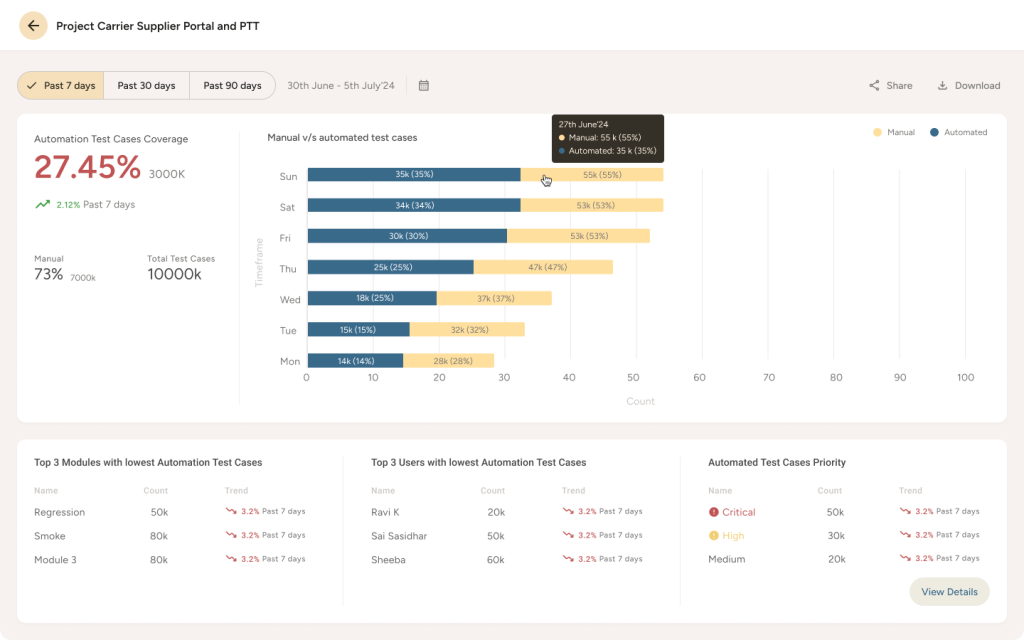
3. Insightful dashboards - visibility is a design principle too
Muffins' dashboards empower managers with real-time visibility into testing progress, team velocity, and automation coverage. Bottlenecks become visible early. High-priority modules get the attention they need. Resource allocation becomes a data-driven decision, not a gut call.
This closes a loop that most Agile teams leave open: the feedback loop between what's being tested and what's being prioritized. When that loop is tight, quality improves, because teams work with better information.
What makes Muffins different from traditional test automation?
Traditional test automation platforms/tools require skilled programmers, and are slow to set up and expensive to maintain. And they treat design as someone else's problem.
Muffins is built on the philosophy that design is the foundation of effective automation. Poorly designed test cases produce poor automation, no matter how sophisticated the tooling is. By combining:
- A no-code interface that democratizes test design
- Generative AI that accelerates test case creation
- Self-healing algorithms that reduce maintenance
- Integrated dashboards that close the feedback loop
Muffins makes it possible to apply Design Thinking principles throughout the entire testing lifecycle, not just at the beginning.
To conclude – Design Thinking is not a phase but practice
The quality crisis in Agile is caused by systems and tools that make it easy to skip design under pressure. The solution is not to slow down, but to build Design Thinking into the tools themselves, so that it happens naturally, at every stage, for every team member.
This is what Muffins' Intelligent Design Studio is designed to do- a practical, tool-supported path to bringing Design Thinking back into Agile.
Frequently asked questions
It bridges the gap between test design and execution by enabling seamless integration & reducing misalignment between designers and automation engineers. This means less rework, streamlined collaboration, and a customer-centric approach with high-quality, automatable designs.
Four standout capabilities:
1. A no-code interface for plain-English test creation
2. Self-healing algorithms that adapt automatically to UI changes
3. Real-time dashboards for visibility into velocity and coverage
4. End-to-end integration connecting design, execution, CI/CD, and defect tracking.
Traditional tools require coding expertise, carry high maintenance overhead, and treat design separately from execution. Muffins integrates design and execution in one platform, makes test creation accessible to non-programmers, and uses AI to handle the repetitive work - so human testers can focus on judgment, edge cases, and collaboration.
Self-healing algorithms automatically detect and adapt to application changes, minimizing the need for manual script updates. This reduces the time teams spend on maintenance and frees them to focus on higher-value design and testing work.
Anyone involved in quality: QA engineers, developers, product managers, domain experts, and business analysts. The no-code interface is built specifically so that the people closest to user needs can contribute directly to test design.
Subscribe today.
Thank you!
Seamless integration of Design & Execution
Muffins’ Intelligent Design Studio
More related blogs

The Big Trends shaping Software Testing and Quality Assurance in 2025
- January 21, 2025

Smarter Verification and Object Management for Regulated industries
- September 11, 2025

Structured & Traceable QA for a Mexico-based top Entertainment ticketing company
- May 14, 2025